
Open research artifacts from the Graphics & Spatial Computing Lab. Everything on this page — LiDAR benchmarks, annotated datasets, and reference implementations — is released to the community so that our results can be reproduced, extended, and improved. If you build on any of these resources, please cite the accompanying paper.
Datasets & Benchmarks
Curated data with ground-truth annotation, evaluation protocols, and baseline results.
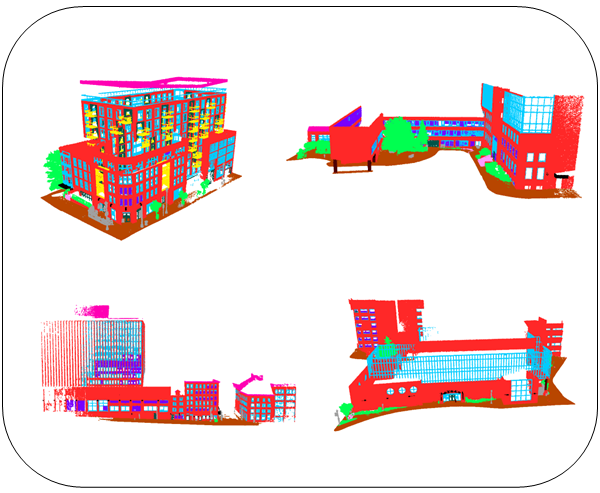
HFX3D — A LiDAR Benchmark for Semantic Segmentation and Functional Understanding of Urban Building Facades
HFX3D is a large-scale LiDAR benchmark for 3D facade understanding, captured across Halifax, Nova Scotia with a handheld ZEB Horizon scanner. It spans commercial, residential, institutional, and waterfront buildings — from historical masonry to contemporary glass curtain walls — recorded across four seasons and varied lighting. To our knowledge it is the first facade benchmark to provide all three annotation tiers: semantic, instance, and functional labels.
The release includes an interactive 3D explorer, train/val/test splits, and baseline results for seven leading 3D segmentation architectures (KPConv, PTv3, PTv2, DGCNN, RandLA-Net, PointNet++, PointNet), exposing the challenges unique to close-range architectural LiDAR.
HFX3D: A LiDAR Benchmark for Semantic Segmentation and Functional Understanding of Urban Building Facades. Graphics & Spatial Computing Lab, Saint Mary’s University. Paper under review — citation to follow.
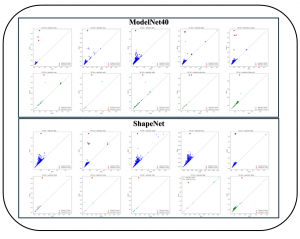
Topological Signatures for 3D Shapes — Precomputed Persistent Homology for ModelNet40 & ShapeNet
Persistent homology gives learning models a powerful, deformation-invariant view of 3D shape — but computing it from point clouds involves expensive filtration and complex construction, and doing so during training is prohibitively slow at scale. To remove that bottleneck, we release precomputed topological signatures for the full ModelNet40 and ShapeNet benchmarks, so the topological deep learning community can train and experiment without paying the persistent-homology cost on every epoch.
The signatures accompany our work on persistent-homology-based learning for 3D understanding, and are drop-in ready for classification, retrieval, and representation-learning pipelines. Code for generating and consuming the signatures is provided alongside the data.
Accompanies: P. Kudeshia, J. Poovvancheri, A. Ghoneim, D. Chen, A Persistent Homology Design Space for 3D Point Cloud Learning; P. Kudeshia, J. Poovvancheri, Learning Significant Persistent Homology Features for 3D Shape Understanding; and P. Kudeshia, M. A. Agowun, J. Poovvancheri, Learning Geometric Complexes for 3D Shape Classification (SMI 2024). Computers & Graphics, Elsevier.
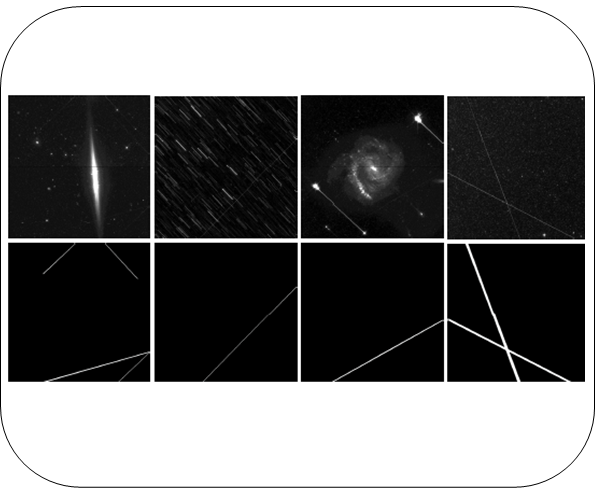
SatStreaks — Supervised Learning for Delineating Satellite Streaks in Astronomical Images
As satellite mega-constellations grow, streak contamination has become a real problem for ground- and space-based astronomy — yet pixel-accurate training data for streak segmentation has been scarce. SatStreaks fills that gap with 3,130 densely annotated, real images of satellite streaks drawn from NASA’s Satellite Streak Watcher citizen science project and the Hubble Asteroid Hunters archive, with ground-truth masks produced through a dedicated citizen-science annotation campaign.
Alongside the data, we provide an experimental evaluation of classical and deep segmentation methods and an Enhanced U-Net (FPN, dilated convolutions, and attention) that reaches 94.4% accuracy and an 88.9 F1 score on the benchmark.
S. Chatterjee, P. Kudeshia, N. Kollo, M. A. Agowun, J. Peethambaran, Y. Akiyama. SatStreaks: Towards Supervised Learning for Delineating Satellite Streaks from Astronomical Images. 21st Conference on Robots and Vision (CRV), 2024.
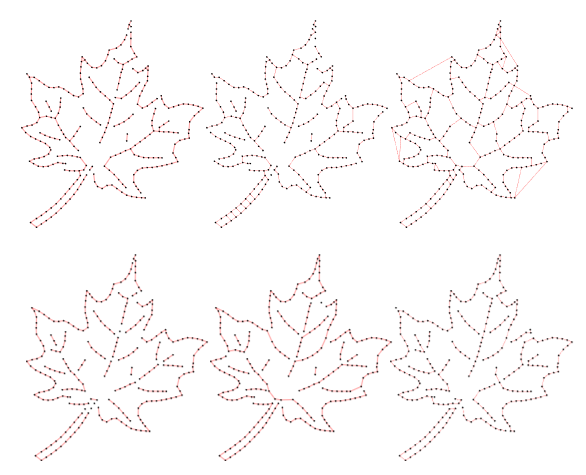
Curve Reconstruction Benchmark — Survey & Open Evaluation Framework for 2D Curve Reconstruction
Reconstructing a curve from unstructured planar points is a decades-old problem with dozens of competing algorithms — and, until this work, no common yardstick. Accompanying our Eurographics survey of 36 curve reconstruction methods, this open-source benchmark provides a unified framework that evaluates 14 representative algorithms against ground truth on unorganized points, boundary samples of binary images, and samples of smooth curves, covering open, sharp, multiple, and non-manifold outlines.
The framework is designed for reproducibility: all results in the paper can be regenerated from the repository, and new algorithms can be plugged in with minimal effort — making it the standard testbed for follow-up work in the area.
S. Ohrhallinger, J. Peethambaran, A. D. Parakkat, T. K. Dey, R. Muthuganapathy. 2D Points Curve Reconstruction Survey and Benchmark. Computer Graphics Forum 40(2): 611–632 (Eurographics STAR), 2021.
Software
Reference implementations and interactive tools from our publications.
OpenSN — An Open Library for Synthetic & Procedural Noise
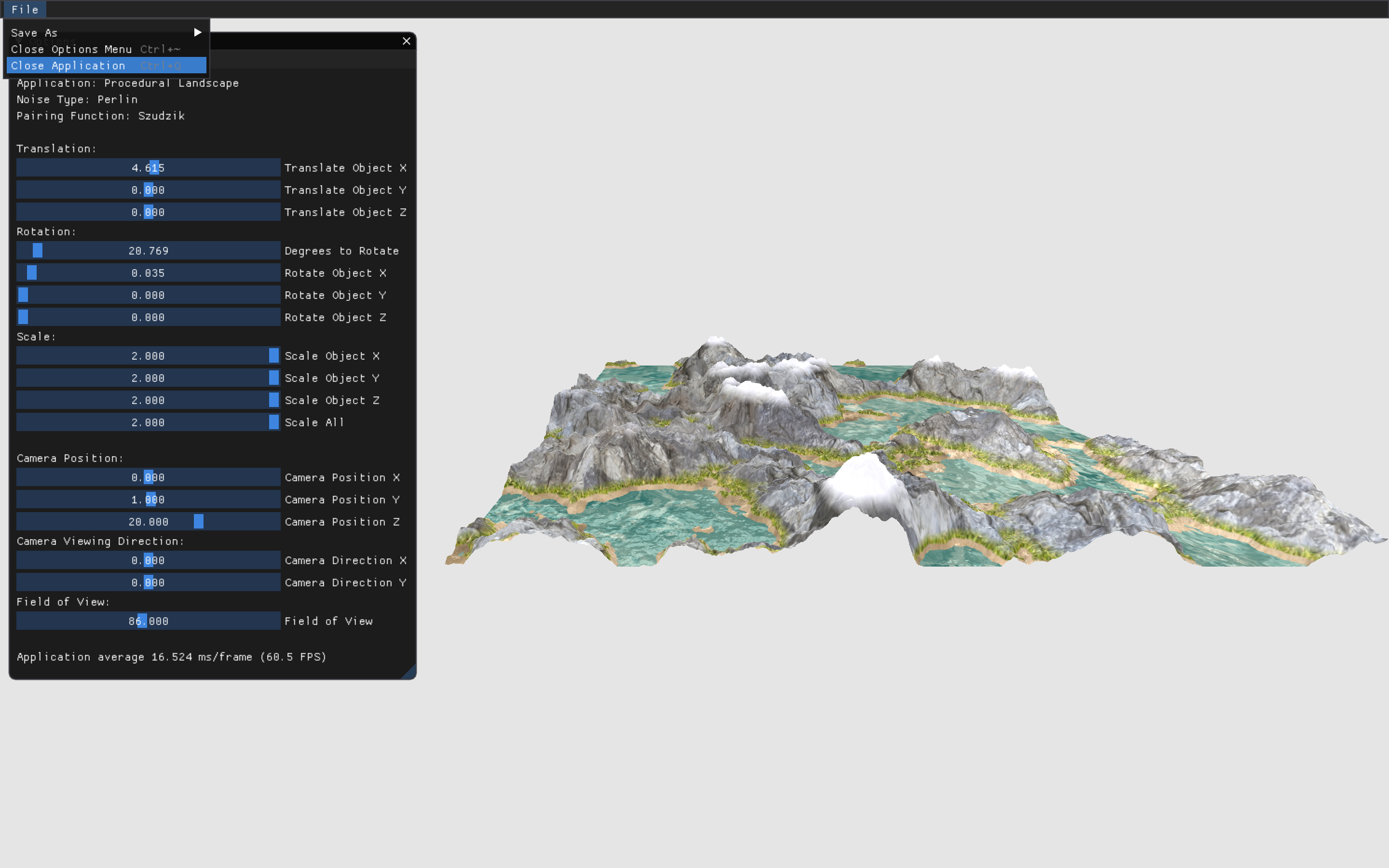
OpenSN is an open-source C++ workbench for procedural noise generation and analysis. It implements ten noise models — including Perlin, Gabor, Worley, wavelet, phasor, better gradient, and our own prime gradient noise — over five interchangeable lattice hashing schemes (linear, Cantor, Szudzik, Rosenberg–Strong, and classic Perlin permutation), so the interaction between hashing and noise quality can be studied directly.
A Dear ImGui interface lets you tweak parameters and apply noise to procedural textures and terrain in real time, while built-in amplitude and Fourier analysis modes export spectra to CSV for quantitative comparison. OpenSN grew out of our research on prime gradient noise, a parameterized lattice noise that reduces visible periodicity while improving efficiency.
S. Taylor, O. Sharpe, J. Peethambaran. Prime Gradient Noise. Computational Visual Media 7(3): 349–362, 2021.
Shapehull3D — Delaunay Sculpting for Watertight Surface Reconstruction
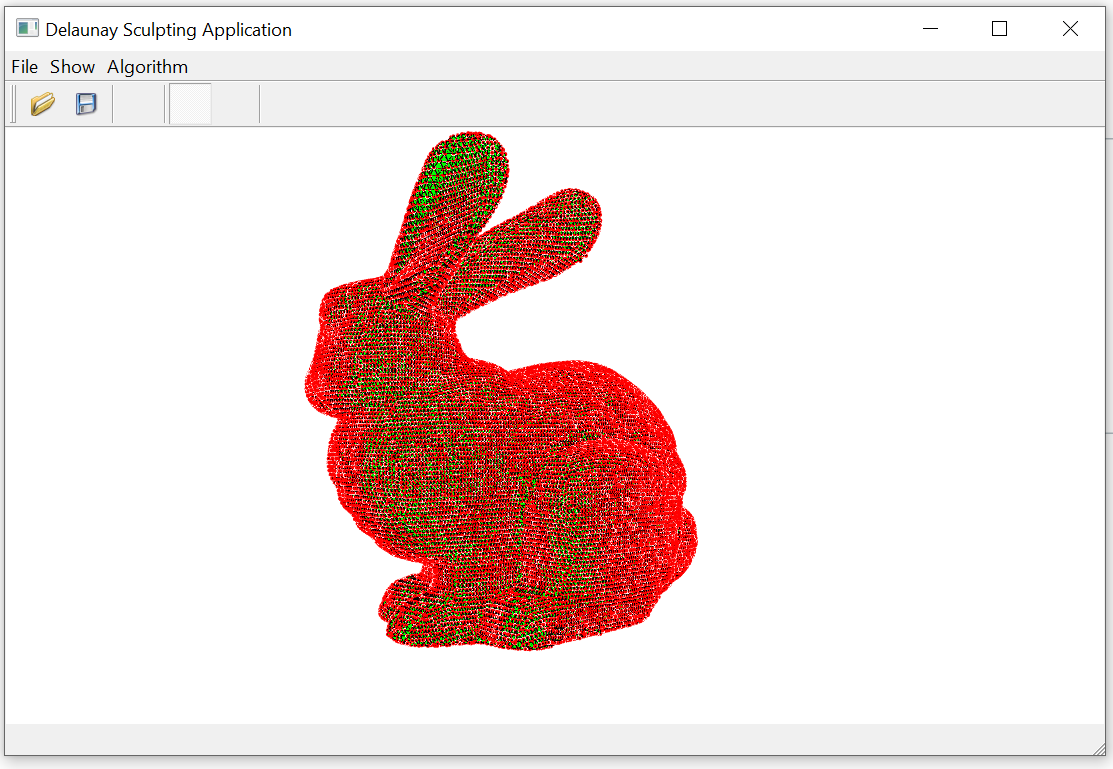
Shapehull3D reconstructs watertight triangular surfaces from raw, unorganized point clouds by repeatedly eliminating Delaunay tetrahedra under circumcenter and topological constraints — a sculpting approach with a theoretical topological guarantee on the resulting 3D shape-hull. Unlike many competing sculpting methods, it is non-parametric and single-stage: no parameter tuning, no multi-pass pipelines.
The tool ships with a Qt interface for loading point clouds and inspecting the reconstructed mesh, and is built on the exact geometric predicates of CGAL. It performs particularly well on models with sharp features and sparsely sampled point clouds.
J. Peethambaran, R. Muthuganapathy. Reconstruction of Water-tight Surfaces through Delaunay Sculpting. Computer-Aided Design 58: 62–72 (SPM 2014), 2015.